
Every camper is aware of a certain moment. The sky suddenly opens up while you’re comfortable, enjoying the warmth, and perhaps halfway through your second cup of coffee. Not even a drizzle. A torrential downpour accompanied by thunder moving in from an unidentified location.
You can relax and take in the spectacle if you have a thunderfly tarp set up. You’re scrambling if you don’t.
Everything you need to know about thunderfly tarps is covered in this book, including what they are, why they are useful, how to choose one, how to set it up, and how to keep it in good condition for many years of travel. In addition, there are three brands worth examining and responses to the most often asked questions.
What Is a Thunderfly Tarp, Exactly?
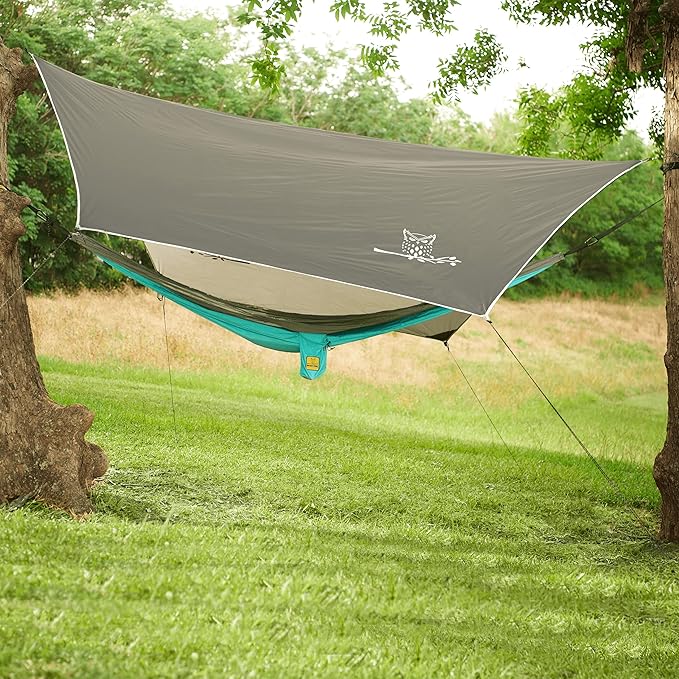
A thunderfly tarp is a huge, waterproof sheet that is stretched between trees, poles, or stakes to provide cover below. It is typically composed of canvas, nylon, or polyester. It lacks walls and a floor, in contrast to a tent. Part of its purpose is that it is open on the sides.
The configuration is where the term “thunderfly” originates. The tarp sheds rain like a wing when it is pitched at a sharp angle and one side is drawn low to the ground. Does the rain come from the wind? It is angled aside by the tarp. In severe weather, the silhouette begins to resemble something designed for speed, which is why the moniker is becoming popular among campers.
Thunderfly tarps can be utilised as social gathering places on multi-day group excursions, as freestanding shelters, as porch covers over tent entrances or as cooking areas to keep your stove dry. They are among the most adaptable pieces of equipment you may have.
Why Campers Choose a Tarp Over a Traditional Shelter
A typical dome tent has a floor, four walls and a zipper. That’s fantastic for sleeping, but when it rains sideways for six hours, you have nowhere to live.
Another issue is resolved by a thunderfly tarp. You may cook, dine, dry off equipment, play cards, or simply sit and watch the storm without being confined inside a nylon tube thanks to the usable covered space it provides. Here’s why seasoned campers vouch for them:
Weight. A decent silnylon tarp weighs under 500 grams. Your tent weighs two or three kilos. Backpackers doing long routes often ditch the tent entirely and go tarp-only.
Ventilation. Condensation is the enemy in any enclosed shelter. Tarps don’t have this problem because air moves freely. Hot nights in summer? You’re sleeping in the open air with rain cover overhead.
Flexibility. The same tarp that covers your campfire kitchen can be pitched low and tight in a gale or opened wide on a calm evening. You adjust to the conditions.
Cost. A quality thunderfly tarp costs a fraction of a quality four-season tent. For campers who are still building out their kit, a good tarp is often the smarter first investment.
Tarps require more ability to pitch effectively, which is a trade-off. Insects enter. If things aren’t put up properly, wind can find angles that cause issues. However, most people never look back once they get the hang of it.
How to Buy a Thunderfly Tarp, What to Actually Look For
People wind up with something that leaks by the second trip when they walk into an outdoor store and choose the first tarp that is reasonably priced. What makes a good purchase different from a regret?
Material
Silnylon, polyester, and canvas (cotton or polycotton) are the three primary materials you’ll see.
Backpackers like silnylon, which is nylon covered with silicone. It is sturdy, lightweight, compact, and effective in shedding water. The drawback is that it can expand when wet, which occasionally causes your pitch to change overnight.
Although slightly heavier, polyester maintains its shape better when it rains. For car campers or anyone who doesn’t care about grams, this is a good compromise.
Canvas is hefty, sometimes three or four times heavier than silnylon, but it breathes, manages condensation effectively, and is quite robust and feels appropriately sturdy in a storm if you’re going on basecamp-style treks where weight is not an issue.
Size
A three-by-three-meter tarp sounds large. Then you try to squeeze a cooking stove, two bags and two people underneath it during a deluge, and all of a sudden it’s not. 3×3 is acceptable for individual use. 3×4 is more comfortable for two people with equipment. 4×5 or larger should be considered for groups of four or more.
Hydrostatic Head Rating
This figure indicates a product’s level of waterproofness. The water resistance is measured in millimetres; the greater the value, the better. Waterproofing anything less than 1,500mm is quite difficult. Look for 3,000 mm or more of rain in real weather. Serious all-weather tarps frequently reach 5,000 mm or more.
Tie-Out Points and Reinforcements
The attachment points around the edges should be counted. They provide you with more setting possibilities, thus more is better. Above all, make sure that every tie-out is strengthened. A tarp is worthless if it rips at the eyelets in a high wind. At the very least, look for reinforced corners and ripstop fabric.
Guy Lines and Pegs
Some tarps come with guy lines and pegs. Most of the decent ones don’t — manufacturers assume you’ll buy your own. Titanium or aluminium tent pegs are worth it. Cheap steel pegs bend in hard ground and rust.
How to Set Up a Thunderfly Tarp
A quality tarp, properly cared for, can last ten or fifteen years. The things that kill tarps prematurely are almost all avoidable.
Dry before packing. Stuffing a wet tarp into a bag and leaving it for two weeks is how you get mildew. Mildew degrades the fabric and the waterproof coating from the inside. If you can’t dry it out at camp, hang it as soon as you get home.
Reapply DWR treatment every season or two. Most tarps have a Durable Water Repellency (DWR) coating that causes water to bead and roll off. This wears down over time. You can buy spray-on DWR treatment at any outdoor shop for a few pounds. Heat-activating it with a tumble dryer on low after application helps it bond better.
Check seams after heavy use. The seams are the weak point on any waterproof fabric. Seam sealer is cheap, a quick pass along the seams before the season starts keeps them tight.
Store loosely, not compressed. Long-term compression degrades the waterproof coating. Hang it or fold it loosely in a dry cupboard rather than leaving it stuffed in its stuff sack.
Clean it correctly. Mild soap and cold water, hand-washed. No machine washing, no hot water, no detergent with bleach or fabric softener. Both strip the DWR coating fast.
Three Brands Worth Looking At
The tarp market has got crowded over the past decade. Here are three brands that have built real reputations for quality rather than just marketing.
1. DD Hammocks
Based in the UK, DD Hammocks started in hammock camping and expanded into tarps. Their XL Tarp (3×3.5 metres) has become something of a benchmark in the budget-to-mid-range category. It comes with 19 attachment points, weighs around 650 grams, and is made from a 70D ripstop nylon that holds up well to hard use. The included stuff sack and guy lines are genuinely useful rather than an afterthought. Price sits around £60–80 depending on where you buy it, which makes it one of the better value-for-money options out there.
2. Hilleberg
Swedish brand Hilleberg is known for building things that last. Their Tarp 20 UL is a proper lightweight option — under 500 grams and made from silicone-coated ripstop nylon. It’s not cheap (expect to pay £200+), but the construction quality is noticeably different from budget options. If you’re doing exposed mountain routes or multi-week wilderness trips, Hilleberg is the kind of kit that doesn’t give you problems at 2am in a storm. Their products are made to be repaired and serviced too, which is increasingly rare.
3. Sea to Summit
Australian brand Sea to Summit makes some of the most thoughtfully designed outdoor kit around. Their Escapist Tarp range comes in three sizes (small, medium, large) and uses a 15D silnylon that is remarkably light for how strong it is. The small weighs 173 grams — practically nothing. They’ve also put real thought into the geometry: the cut is designed to pitch well in multiple configurations without the awkward slack you sometimes get with cheaper rectangular tarps. Available in most major outdoor retailers. Mid-range pricing, around £80–130 depending on size.
5 Frequently Asked Questions
1. Can I use a thunderfly tarp instead of a tent?
Yes — many experienced backpackers go tarp-only, often paired with a bivy bag for insect and damp protection while sleeping. It saves significant weight and can be more comfortable in warm weather. That said, tarps require more skill to set up well and offer less protection in extreme cold or bug-heavy environments. If you’re new to camping, it’s worth getting comfortable with a tarp alongside a tent before relying on it as your only shelter.
2. How do I stop bugs getting in under a tarp?
You can’t seal out insects the way a tent does. The practical solutions are a bivy bag or inner tent, a bug net hammock if you’re sleeping off the ground, and pitching near open breezy spots rather than sheltered still-air areas where insects tend to gather. Treating clothing and exposed skin with repellent matters more when you’re sleeping under a tarp.
3. What’s the best tarp configuration for heavy rain?
The A-frame pitched low and tight, with one end staked close to the ground to face the prevailing wind. Steep pitch angles shed water faster than shallow ones — if you can get each side at around 45 degrees, you’re in good shape. Avoid pooling by making sure there are no flat spots in the tarp where water can collect and sit.
4. Do I need special knots to rig a tarp?
You don’t need to know many — but knowing a few well is better than knowing lots badly. The trucker’s hitch is the most useful one to learn: it lets you tension your ridgeline easily and adjust it under load. A taut-line hitch on your guy lines lets you adjust tension without re-tying. That’s honestly most of what you need for 95% of situations.
5. How do I know if my tarp’s waterproofing is starting to fail?
Pour a small amount of water onto the fabric. If it beads up and rolls off, you’re fine. If it soaks in and darkens the fabric (this is called “wetting out”), your DWR coating has degraded and needs refreshing. This doesn’t mean the tarp leaks immediately — the main waterproof membrane underneath may still be intact — but it will feel clammy and let water transfer through under sustained rain. Reapply DWR treatment before your next trip.
Final Thoughts
A thunderfly tarp is not an opulent piece of equipment. There aren’t many features to take pictures of or spec sheets to become fixated on. It has two features that are far more important when you’re out in the field and the weather is acting as it pleases: simplicity and usefulness.
If you haven’t already, start with a mid-range model like the DD Hammocks XL, practise pitching it in the garden a few times, and take it on a trip where you have a backup tent. It’s likely that by the time that trip is over, you’ll know exactly what’s going on.
Be careful not to get wet.