
Tent listings are very good at making every tent sound ready for anything. “All-weather.” “Extreme conditions.” “Perfect for year-round adventure.” After a while the descriptions blur together, and you can’t tell which tent will actually keep you comfortable when the temperature drops.
The truth is that a handful of features do most of the work in cold weather. Everything else is mostly marketing or personal preference. If you know what those few features are, you can look at almost any tent and decide in a couple of minutes whether it’s worth your money.
This guide goes through them in plain terms, including the ones people tend to overpay for.
1. Season rating: read it, but don’t treat it as law
Tents are usually labeled by season, and it’s a decent starting point.
- 3-season: Light, well ventilated, built for spring through fall. Many can handle a cold night in late autumn if you set them up well.
- 3-season+ / extended season: Sturdier and a bit more enclosed. A good fit for cold, windy trips without heavy snow.
- 4-season (winter): Stronger frame, heavier fabric, and designed to handle snow and strong wind.
There’s no official standard behind these labels, so two tents with the same rating can behave very differently. Use the rating to narrow your list, then check the details below. If you’re mainly camping in late November or December in a mild or moderate climate, an extended-season tent is often the sweet spot. A full 4-season tent is worth it only if you expect real snow or exposed, windy sites.
2. Double-wall construction
If you take only one thing from this article, take this one.
A double-wall tent has a breathable inner tent and a separate waterproof rainfly. In cold weather, that matters because the moisture from your breath collects on the outer layer instead of dripping onto you. Single-wall tents can work, but they’re far more prone to condensation, and condensation is the thing that makes cold nights miserable.
Look for a rainfly that reaches close to the ground. A short fly that leaves a big gap at the bottom lets in wind and cold air.
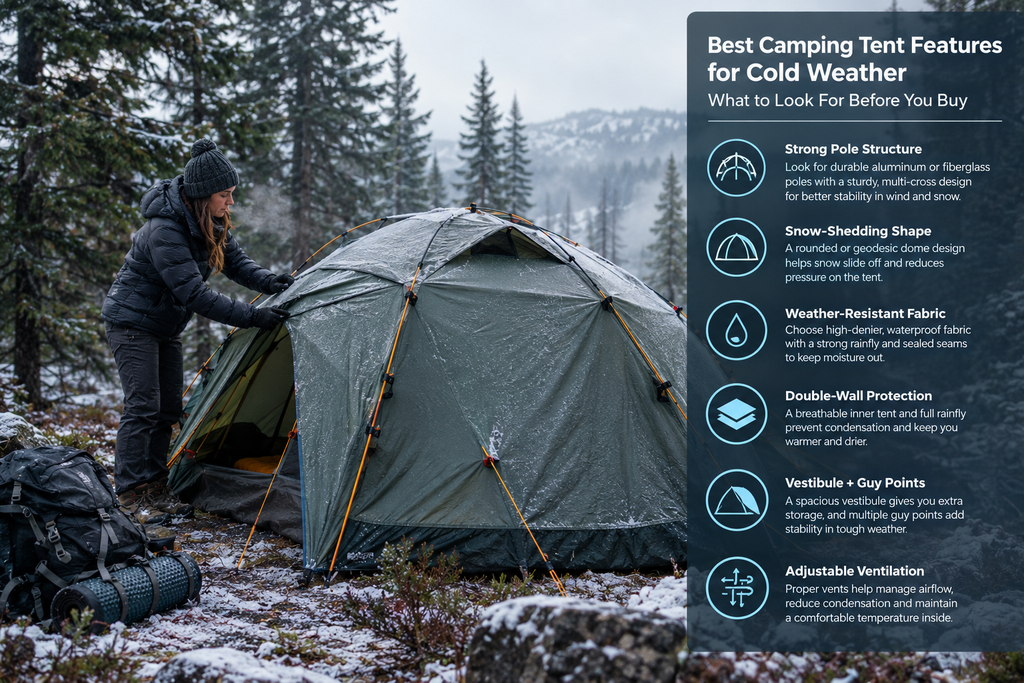
3. A strong, well-designed pole structure
Wind and snow load put real stress on a tent, and the poles are what hold it up.
- Material: Aluminum poles are generally stronger and more reliable in cold than fiberglass. Fiberglass can become brittle and splinter in low temperatures.
- Number of crossing points: A frame with more crossings (a dome or geodesic design) usually handles wind and snow better than a simple two-pole tent.
- Shape: Steeper walls shed snow more easily. Flat or very boxy tents tend to collect it.
If you’d like a deeper look at metals and frames, our comparison of aluminium vs steel frames explains how they differ in weight and durability.
4. Waterproof ratings and fabric
You’ll often see a number like “2000mm” in the specs. That’s the hydrostatic head rating, and it gives you a rough idea of how much water pressure the fabric can take before leaking. Higher is better, though real-world performance also depends on seams and how the tent is pitched.
A few practical points:
- Look for a rainfly with a rating suitable for your conditions, and a tent floor with an even higher rating, since the floor is under pressure from your weight and wet ground.
- Check that the seams are factory taped. Untaped seams are a common leak point.
- Be careful with very thin, ultralight fabrics if you expect rough weather. They save weight but can be less durable.
5. Ventilation you can control
It sounds odd to look for ventilation in a cold-weather tent, but it’s one of the most useful features you can have.
Good cold-weather tents have vents you can open and close. That lets you seal things up when it’s windy and open them a little at night to let moisture out. Look for:
- Adjustable vents high on the tent, near the roof
- A rainfly with its own vents or peaks
- Doors with mesh panels you can zip over with a solid layer
A tent with no way to adjust airflow will either feel like a fridge or a sauna with dripping walls.
6. A roomy vestibule
The vestibule is the covered area outside your inner tent door, and in cold weather it’s close to essential.
It’s where wet boots, packs, and muddy gear go, so they stay out of your sleeping space. It’s also useful for storing things you don’t want freezing or soaking overnight. Check the size and whether the door zips fully, so that wind and snow don’t blow in.
7. Plenty of guy-out points and stake loops
Wind is a bigger issue in cold months. A tent that can be anchored from many points stays stable and quiet in a gust. Look for multiple guy-line attachment points on the fly, reflective guy lines (they save you from tripping in the dark), and sturdy stake loops. If you’ve had trouble with anchoring, our post on stopping your camping canopy from flying away in wind has tips that apply to tents too.
8. A snow skirt or flaps (if you’ll see snow)
Some winter tents have a skirt, a flap of fabric around the bottom edge that you can weigh down with snow or gear to block drafts. If you expect snow, it’s a helpful extra. For ordinary cold, rainy camping, it isn’t necessary.
9. Durable zippers and easy doors
Cold fingers and gloves make small details matter. Look for large zipper pulls you can grab with gloves on, covered or protected zippers, and doors that are easy to open from the inside. A zipper that snags in the dark at 2 a.m. is a small thing that feels huge.
10. The right size
As covered in our guide on keeping a tent warm without a heater, a snug tent holds heat better than a big one. Choose a size that fits your group plus a little extra, not a large family tent for two people. If you carry a lot of gear, a good vestibule often solves the space problem better than a bigger inner tent.
Features you can skip
Some features sound useful but don’t matter much for most campers:
- Extra-large storage pockets and fancy organizers. Nice, but not what keeps you warm.
- Built-in lighting or gadgets. Handy at times, but not worth paying extra for in cold weather.
- Tents with huge mesh areas. Great in summer, but they let in a lot of cold.
- Heavy 4-season construction if you only camp in mild conditions. You’ll carry extra weight and may get a stuffier tent.
Quick buying checklist
- Season rating that matches your real conditions
- Double-wall design with a full-coverage rainfly
- Aluminum poles and a sturdy dome-style frame
- Taped seams and a durable floor
- Adjustable vents
- Good vestibule space
- Multiple guy-out points
- Glove-friendly zippers
- Size that fits your group without wasted space
FAQs
What is the most important feature in a cold weather tent?
Double-wall construction with a full rainfly and adjustable vents. It controls condensation, which is the biggest comfort issue in cold weather.
Do I need a 4-season tent for December camping?
Not always. In mild or moderate conditions, a good 3-season+ tent works well. Choose a 4-season tent if you expect snow or high winds.
Are aluminum poles better than fiberglass in the cold?
Generally yes. Aluminum is stronger and holds up better in low temperatures, while fiberglass can become brittle.
Should a cold weather tent have a lot of mesh?
Less mesh helps hold warmth, but you still want some adjustable ventilation to manage moisture.
How do I look after my tent after a cold trip?
Dry it completely before storing and keep it in a cool, dry place. Our guide on how to clean and store your camping tent walks through the full process.
Final thoughts
You don’t need the most expensive tent on the shelf to camp comfortably when it’s cold. You need one built around the basics: a good frame, a full rainfly, controllable ventilation, and a layout that keeps your gear dry. Get those right, and the rest is detail.
If you’re still choosing where to start, our December camping tent guide is a good companion to this one.