

Walk into any outdoor retailer and you’ll see the same canopy tent offered in two versions: one with an aluminum frame and one with a steel frame. The steel version costs somewhat less. The aluminum variant costs somewhat extra. The product photographs appear almost identical. And the descriptions are almost useless, stating things like ‘durable steel frame’ and ‘lightweight aluminum construction’ without providing anything to compare.
They fail to mention that steel and aluminum behave somewhat differently in the outdoors. In coastal air, one corrodes while the other does not. While the other may need to be carried by two persons, the first is truly portable. When under load, one flexes, while the other may break.
The “right” decision is largely dependent on how and where you camp; making the wrong decision could result in a heavy, rusting frame or a fragile one failing in unsuitable conditions.
I’ve made great use of both. Instead of merely speculating solely on price, you may make a truly informed choice by using this guide, which breaks down every pertinent distinction.
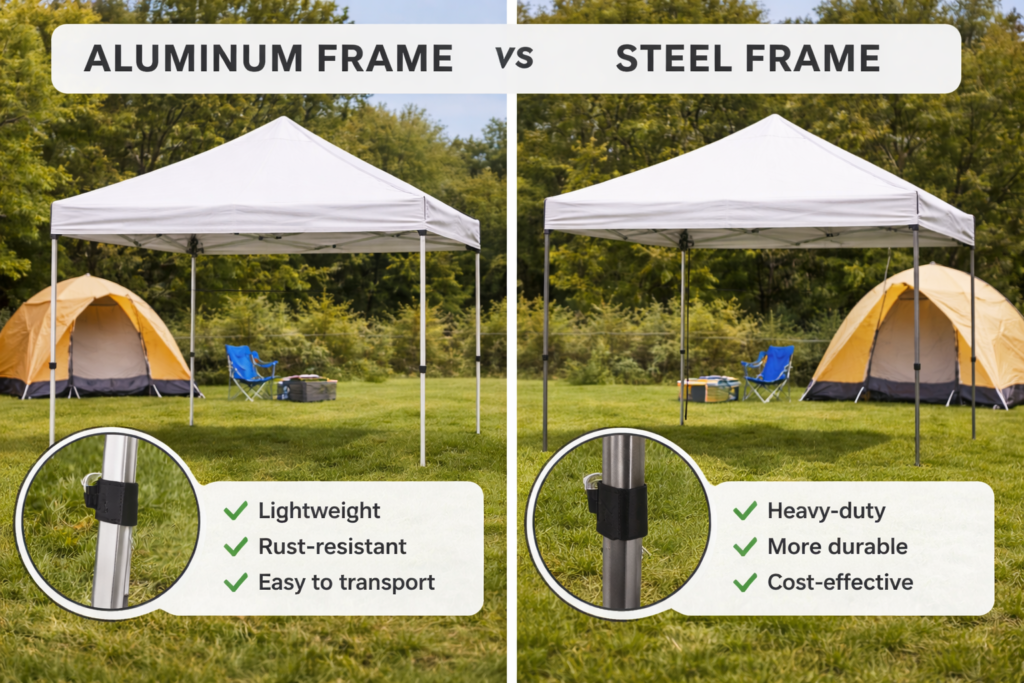
The Core Difference: What Are These Materials, Actually?
Knowing what you’re really comparing is helpful before comparing performance.
Iron and carbon combine to form steel. It’s one of the most common structural materials on earth — strong, rigid, and inexpensive to manufacture. In order to prevent corrosion, the steel used in canopy frames is almost always coated (galvanised, powder-coated, or both). However, if the coating is compromised, the core material will eventually rust.
A naturally occurring metal, aluminum weighs around one-third as much as steel for the same volume. It oxidizes, but aluminum oxide creates a barrier that stops additional corrosion, so it doesn’t rust. Aluminum canopies are usually more expensive than steel because they are more costly to manufacture and process.
In terms of structure, steel is stronger per unit, but aluminum has a competitive strength-to-weight ratio when you take into consideration that aluminum buildings are frequently made thicker to make up for their lower density. The real-world performance difference between a high-quality steel frame and a high-quality aluminum frame is not as great as most people think; the biggest distinctions are in weight, long-term maintenance, and rust resistance.
Weight
On paper, the weight difference between an aluminum frame canopy and a steel frame canopy of the same size could be five to ten pounds. It doesn’t seem like much. But in the context of camping, think about what those five to ten pounds really mean.
You are transporting your canopy from the vehicle to the campground. Then back again. After that, it was stored. Then out once more. Over the course of a season, those extra pounds build up to actual exhaustion if you camp frequently. The difference between a 25-pound aluminum canopy and a 35-pound steel one could mean the difference between being able to set it up by yourself and actually having trouble if you’re a lone camper.
Weight is definitely your most essential factor if you camp with elderly family, have mobility concerns, or camp a lot alone. Aluminum wins hands down.
However, the weight difference is mostly insignificant if you car camp in groups, have several people to assist with setup, and don’t move your canopy much while it’s up. In that situation, spending more on aluminum in order to save a few pounds is unnecessary.
💡 Pro Tip: Weigh your canopy (or the one you’re thinking about purchasing) when it’s all packed in its bag, not just the “frame weight” that is claimed.” Sellers frequently exclude the three to six pounds that are added by the bag, stakes, and accessories from their stated weight.
Durability and Strength
This is where it gets nuanced, because ‘durability’ means different things depending on what you’re asking it to withstand.
Impact Resistance
In terms of impact resistance, steel prevails. Steel is more forgiving when a steel frame is set up on uneven ground where legs are subjected to side-loading stress or when it is struck against rocks during transportation. It is frequently possible to bend back a bent steel joint. When an aluminum joint fails, it usually cracks instead of bending, which is a terminal failure.
This is especially important if you camp in difficult areas, pack your stuff carelessly, or have children that handle camping gear like, well, camping gear. This benefit is almost meaningless in laid-back campsite environments when the canopy is managed carefully.
Long-Term Weather Exposure
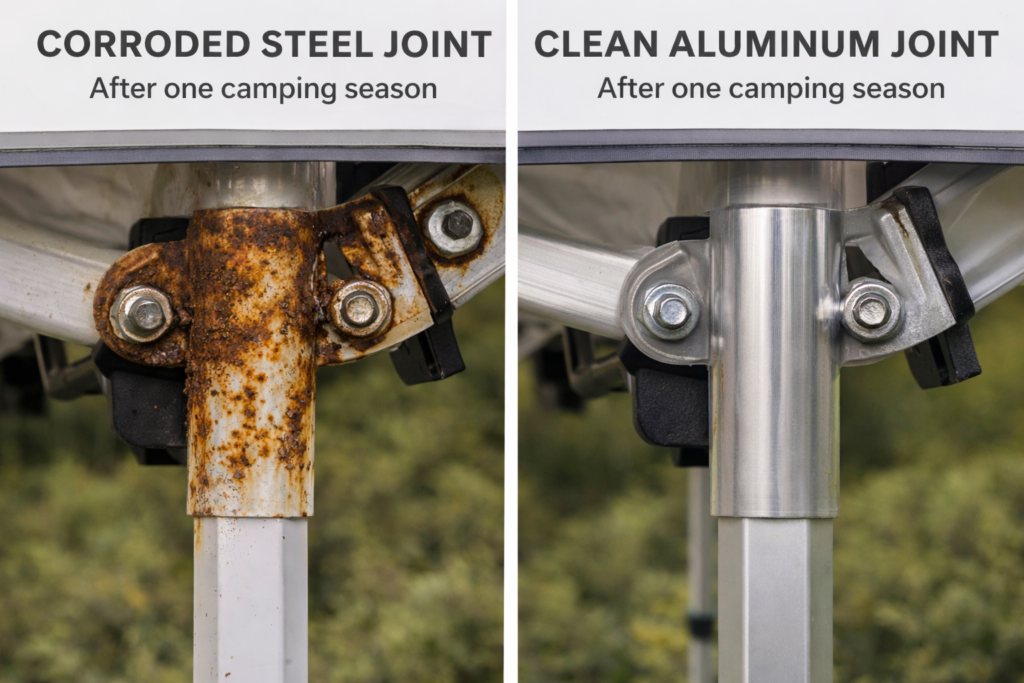
Long-term weather resistance goes to aluminum, and it’s not even close. The only thing that keeps steel frames from rusting is their coating. Bare steel is exposed to moisture with each nick, chip, or scratch in the coating. Rust spreads silently beneath the paint once it begins, particularly at the frame joints where movement creates wear.
I’ve seen steel-framed canopies that appeared great from the outside but collapsed during erection due to interior joint connector corrosion. This is particularly prevalent with canopies used in coastal or high-humidity regions, as well as those kept damp—a condition that all camping canopies eventually experience.
This is not an issue with aluminum. The exposed aluminum just oxidized to a dull gray even if the anodizing or powder coating is scratched; unlike rusted steel, it does not degrade fundamentally.
Frame Bending Under Load
Aluminum frames typically maintain their shape until a failure threshold, at which point they crack, whereas steel frames tend to bend (deform plastically) under excessive wind pressures.
Which is better depends on your point of view: a fractured aluminum joint fails totally but frequently exhibits obvious warning signs before catastrophic collapse, whereas a bent steel frame is damaged but may still work.
If you’re anchoring correctly and bringing down the canopy in a strong wind, neither failure mode is likely for the majority of recreational camping. In commercial or event settings, where canopies remain up for long periods of time in erratic weather, the distinction is particularly important.
Side-by-Side Comparison Table
| Feature | Aluminum Frame | Steel Frame |
| Weight | Lighter (typically 20–28 lbs for 10×10) | Heavier (typically 28–40 lbs for 10×10) |
| Rust Resistance | Excellent — naturally oxidation-resistant | Moderate — depends on coating quality |
| Impact Resistance | Moderate — cracks under extreme impact | Good — bends but less likely to crack |
| Portability | Excellent for solo campers | Better in groups; harder solo |
| Coastal / Humid Use | Ideal | Requires extra maintenance |
| Cold Weather Use | Good | Better — less brittle in freezing temps |
| Price | Higher ($120–$400+) | Lower ($60–$250) |
| Repairability | Harder — cracked joints often unrepairable | Easier — bent steel can sometimes be straightened |
| Lifespan (well-maintained) | 8–15+ years | 4–10 years (coating dependent) |
| Best For | Frequent campers, solo, coastal camping | Occasional campers, groups, budget buyers |
Cold Weather Performance
Aluminum becomes more brittle in extremely cold temperatures, so frame material matters if you camp in late autumn, early spring or at an elevation where nightly temperatures drop below freezing. This is something that most customers never think about.
Aluminum alloys, especially the lower-grade alloys used in inexpensive canopies, may be more vulnerable to impact stress cracking at temperatures considerably below freezing than they would be at room temperature. Steel’s ability to withstand impacts is more reliable at all temperatures.
This distinction is practically meaningless for three-season camping in temperate regions. From a material perspective, steel is the safer option for winter or high-altitude camping where temperatures frequently fall well below freezing and you’re dealing with snow weight on the canopy.
💡 Pro Tip: Always remove snow build-up from your canopy as it accumulates if you camp in almost freezing temperatures. On a 10×10 canopy, even a little layer of wet snow can add 40-80 pounds of stress, which is more than most frame systems can support.
Maintenance
Both frame types need maintenance, but the requirements are different.
Steel Frame Maintenance
- After every trip: Dry the frame completely before storing. Even a few minutes with a dry towel on the joints makes a significant difference. Never store a steel-frame canopy damp.
- Periodically: Inspect all joints and frame sections for coating chips or scratches. Touch up with rust-inhibiting spray paint or a rust converter product.
- Annually: Apply a light coat of WD-40 or silicone spray to all pivot points and joints. This prevents corrosion at the friction points where coatings wear first.
- Watch for: Orange staining on the fabric near joints — this is rust transferring from the frame to the canopy and indicates the coating has failed at that point.
Aluminum Frame Maintenance
- After every trip: Wipe down frame sections and dry the joints — not because of rust risk, but because grit and debris in joints causes wear over time.
- Periodically: Check that all locking pins and button-locks are functioning correctly. These are the most common failure point in aluminum pop-up frames.
- Annually: Inspect for stress cracks at joints, especially if the canopy has been used heavily or in wind. Aluminum cracks are subtle — look for hairline fractures at corners.
- Watch for: White, chalky powder on the frame surface — this is aluminum oxidation and is cosmetically unpleasant but structurally harmless.
Budget Considerations
Steel frames are almost always more affordable than aluminum at the bottom end of the market (less than $100). Usually, a $70 steel-frame canopy is constructed with sturdy welded seams and good-gauge steel. Typically, a $70 aluminum-frame canopy is constructed using inferior alloys and thin-wall aluminum tubing.
Only until you invest enough in high-quality alloy construction—typically 6000-series aluminum alloy—does the aluminum advantage truly become apparent. Reputable companies’ 10×10 canopies start at about $150–$200.
To put it another way, the decision isn’t just “aluminum vs. steel.” It’s “budget aluminum vs. quality steel vs. quality aluminum.” For heavy, frequent use, high-quality aluminum works best. For rare to moderate use, high-quality steel is great. The worst alternative is typically inexpensive aluminum, which is weaker overall and lighter than steel but not significantly more resistant to rust.
Who Should Buy Which: The Honest Verdict
Rather than declaring a single winner, here’s a clear breakdown:
Buy Aluminum If…
- You camp alone: and need to set up and carry the canopy without help.
- You camp in coastal, humid, or wet environments: where rust resistance is critical.
- You camp frequently: 3+ times a year and want the canopy to last a decade or more with minimal maintenance.
- You’re willing to invest: in a quality mid-to-upper-range product (budget aluminum is not recommended).
Buy Steel If…
- You camp occasionally: a few weekends a year and don’t want to overspend on a canopy.
- You camp in groups: where weight during setup and pack-down is shared.
- You camp in cold conditions: at altitude or in late-season temperatures below freezing.
- You have a limited budget: and want the most structural canopy for the money.
Frequently Asked Questions
Q: Does aluminum rust?
A: Aluminum does not rust. Although it oxidizes, aluminum oxide actually shields the metal from additional corrosion by forming a thin, persistent layer on its surface. Aluminum oxidation does not spread or degrade the metal structurally, in contrast to rust on steel. Aluminum oxide is the unattractive but safe white, chalky residue that can be seen on old aluminum.
Q: Is a heavier canopy more wind-resistant?
A: To some extent, but anchoring technique is more crucial for wind stability than frame material. A poorly anchored steel canopy will always perform worse in the wind than an aluminum canopy that is properly staked and guyed. Nevertheless, on extremely flat, hard surfaces where anchoring is challenging, a heavier steel frame’s lower center of gravity does offer slightly better inherent stability.
Q: What canopy frame gauge (thickness) should I look for?
A minimum of 1.5 mm of wall thickness should be included in the leg portions of steel frames. Look for 6000-series or 6061 aluminum alloy when it comes to aluminum; These are frequently mentioned in product specifications for higher-quality companies. Aluminum with thin walls under 1.8 mm in the leg portions is prone to bending and denting.
Q: Is it possible to fix a fractured aluminum frame joint?
A reinforcement sleeve can be slipped over the cracked area or aluminum epoxy can be used to stabilize minor cracks. However, an epoxy patch won’t restore the original structural rating and could fail under load, therefore a joint that has completely cracked should be replaced.
Q: Even though my steel frame canopy is only a year old, the joints are already rusting. Is it destroyed?
A: Not always. A rust converter spray, which chemically changes iron oxide into iron phosphate, can be used to remedy surface rust at joints. Rust-inhibiting paint can then be used as a touch-up. Repaint after cleaning the affected area, applying converter, and let it cure. Replacement is safer when severe rust has gotten into the joint itself.